
Category: Tech Analysis | Reading Time: 9 Minutes
Using a 360 camera urban exploration setup is the most innovative way to document decaying architecture today. Traditional photography forces the viewer to look exactly where the photographer points the lens. However, new spherical video technology allows your audience to look around the entire room and discover the forgotten details for themselves.
This technical analysis dives into the rapidly evolving world of spherical imaging. We will discuss how dual lens systems work, the incredible magic of invisible selfie sticks, and the unique lighting challenges you will face when your camera sees absolutely everything in the room at once.
1. The Mechanics of Spherical Imaging
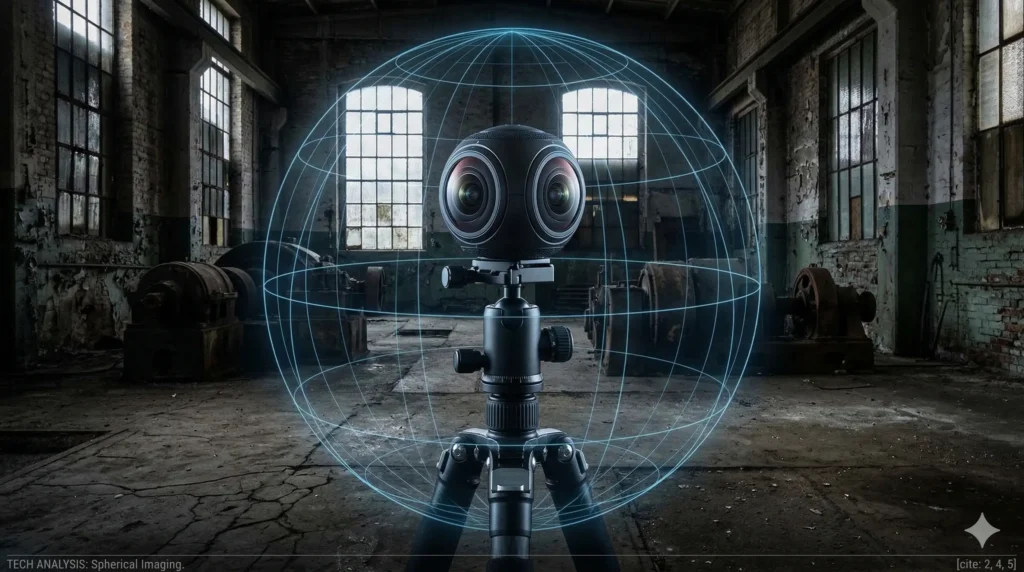
Unlike a traditional DSLR that captures a single flat rectangle of light, a spherical camera uses two extremely wide angle lenses placed back to back. Each lens captures slightly more than a complete half circle of the environment. The internal software of the camera then seamlessly stitches these two massive hemispherical files together in real time.
The result is a complete spherical view of the abandoned location. For the historical archivist, this means you never accidentally crop out an interesting piece of peeling paint on the ceiling or a forgotten medical file resting on the floor. You capture the entire environment in a single press of a button, preserving the complete context of the decaying room forever.
2. Resolution and Sensor Size Limitations
While the concept of capturing everything at once is amazing, there are specific technical limitations you must understand. When a manufacturer advertises an 8K spherical camera, that massive resolution is stretched across the entire three dimensional sphere. Therefore, the actual resolution of the specific area you are looking at on your screen is much lower than a standard 4K flat video.
Furthermore, the physical sensors inside these compact devices are generally quite small. As we learned in our previous low light photography analysis, small sensors struggle heavily in dark environments. To get the best possible image quality, you must use these cameras in well lit areas like massive factory floors with large skylights or hospital wards with abundant natural sunlight streaming through broken windows.
3. The Magic of the Invisible Selfie Stick
One of the greatest advantages of a 360 camera urban exploration rig is the ability to capture impossible third person perspectives. Because the two lenses are mounted back to back, there is a tiny physical blind spot directly beneath the camera body.
If you mount the device perfectly straight on a thin extension pole, the software will completely stitch the pole out of the final video. When you extend this pole ten feet into the air and walk through a crumbling hallway, the resulting footage looks exactly like an expensive drone flying silently above your head. This allows you to safely inspect unstable upper floors or peer over high structural blockages without ever risking an actual drone crash in a tight space.
4. The Extreme Challenge of Lighting
Lighting a spherical scene is the most difficult technical hurdle you will face. With a traditional camera, you can place a bright LED panel directly behind you to illuminate the dark basement. If you try that with a spherical camera, the light panel will be glaringly obvious in the final shot and will completely ruin the immersive experience.
You have two main options for dealing with absolute darkness. The first is to embrace practical lighting by having your exploration partner hold a lantern or a tactical flashlight in the frame, creating a moody and cinematic atmosphere. The second option is a technique called light painting. You place the camera on a sturdy tripod, start a very long exposure, and walk around the dark room flashing a narrow beam of light on specific architectural features. Because you keep moving in the darkness, you will not appear in the final stitched image, but the illuminated walls and machinery will look incredibly dramatic.
5. Post Production and Virtual Reality
The magic of spherical imaging truly comes alive during the editing phase. Using specialized desktop software or mobile applications, you can reframe your footage to create a standard flat video that pans and zooms around the room, mimicking a professional camera crew.
Alternatively, you can export the full spherical files to create interactive virtual tours. By uploading these massive files to a specialized hosting platform, you allow your audience to put on a virtual reality headset and physically step inside the abandoned building. They can turn their heads to inspect the rusted pipes on the ceiling or look down at the shattered glass on the floor, providing an unmatched level of historical preservation and digital access.
Conclusion
Integrating spherical imaging into your workflow completely changes how you document forgotten history. While the hardware requires specific lighting considerations and a unique approach to composition, the ability to transport a viewer directly into an abandoned space is incredibly powerful. As this technology continues to improve, it will undoubtedly become the standard for architectural preservation.
Over to you: Have you ever watched a spherical video or used a virtual reality headset to explore a historic location? Let us know what you thought of the immersive experience in the comments below!