
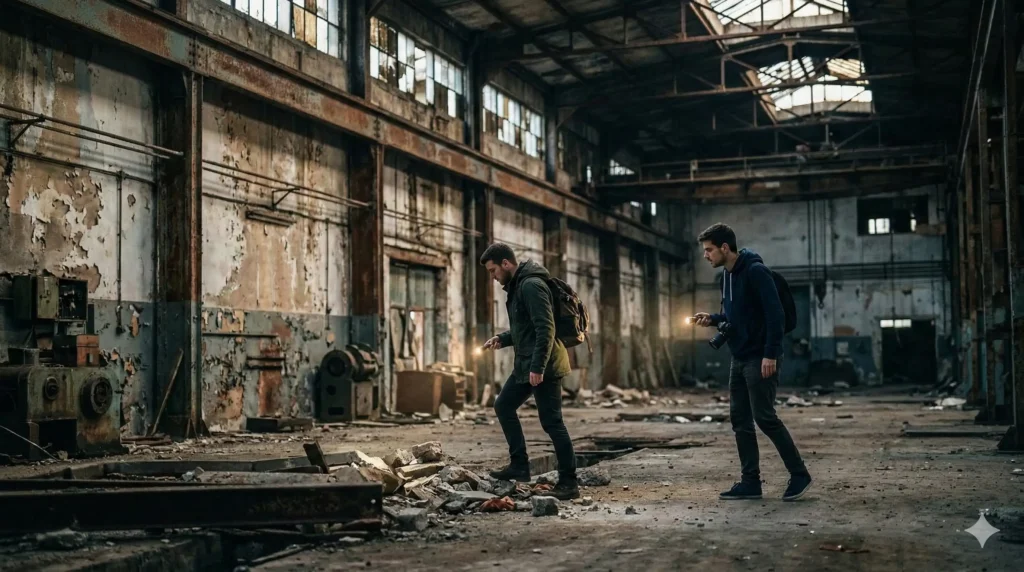
The allure of the solo mission is strong. There is a specific kind of meditation that comes with walking through an abandoned factory in complete silence, with nothing but your own footsteps echoing off the peeling walls. It feels cinematic. It feels brave.
But in the world of urban exploration (urbex), “brave” can quickly turn into “missing.”
Every experienced explorer has a story about a floor that gave way or a door that slammed shut behind them. If you are alone when that happens, a minor accident becomes a life-threatening situation. This is why the “Buddy System” isn’t just a suggestion—it is the most critical tool in your kit. Here is why exploring abandoned buildings alone is a risk you shouldn’t take.
The Myth of the Structural Skeleton
When we look at photos of abandoned asylums or industrial plants, we see the beauty of decay. We rarely see the structural integrity—or lack thereof.
Abandoned buildings are not static; they are actively dying. Water damage rots wooden beams from the inside out. Metal staircases rust until they are paper-thin. [Insert a quick 1-2 sentence story here about a time you or a friend stepped on a “soft spot” or saw a staircase collapse]
If you step onto a compromised floorboard:
- Scenario A (With a Partner): Your friend grabs your backpack, pulls you back, or at the very least, marks the spot so you don’t fall.
- Scenario B (Solo): You fall through to the basement. You break a leg or get knocked unconscious. In a concrete basement with no cell signal, no one knows where you are, and no one is coming to help.
The Human Element: Squatters and Scrappers
Buildings are rarely as empty as they look. While many locations are truly abandoned, others serve as shelters for the homeless or “off-the-grid” individuals. Most squatters just want to be left alone. However, if you startle someone sleeping in a dark room, the reaction can be unpredictable.
Then, there are the scrappers. These are people illegally stripping copper wire and pipes from the building. They are often working fast and can be highly aggressive if they think you are the police or competition. [Insert a brief personal anecdote about a time you heard someone else in a building and had to quietly navigate around them or leave]
Two people walking into a room project confidence and authority. One person walking in alone looks vulnerable. There is always safety in numbers.
The “No Signal” Zone
Thick concrete walls, steel reinforced roofs, and underground tunnels are notorious for killing cell service.
If you twist your ankle, suffer an asthma attack from inhaling black mold, or get cut on rusty metal, you cannot simply call 911. Having a partner means one person can stay with the injured explorer while the other runs back to the surface to get a signal and guide paramedics to the specific entry point.
The Protocol: If You MUST Go Solo
We strongly advise against exploring abandoned buildings alone. However, if you absolutely must go solo to scout a location, you need a strict “Fail-Safe Protocol”:
- Share Your Location: Tell a trusted contact exactly where you are going. Send them the GPS coordinates and a pin drop.
- Set a “Check-In” Time: Tell your contact, “If I don’t text you by 4:00 PM, call the police and give them these coordinates.”
- Stick to the Plan: Do not explore “just one more room” past your time limit. When the clock runs out, you leave.
- Trust Your Gut: If the vibe feels off, leave immediately. No photograph is worth your safety.
Conclusion
Urban exploration is a team sport. The photos might look better without people in them, but the experience is safer, smarter, and often more fun when shared. Find a partner, watch each other’s backs, and make sure you both make it out to tell the story.