
Category: The Lab | Reading Time: 5 Minutes
In an abandoned building, light is life. When you step into the windowless basement of a 1920s hospital, your phone’s flashlight becomes a toy. You aren’t just looking for your car keys; you are looking for holes in the floor, rusted rebar, and potential hazards hidden in the shadows.
However, many explorers make the mistake of buying the “brightest” light they can find without understanding how that light actually behaves. To choose the right tool for the job, you need to understand the two most important numbers on the box: Lumens and Candela.
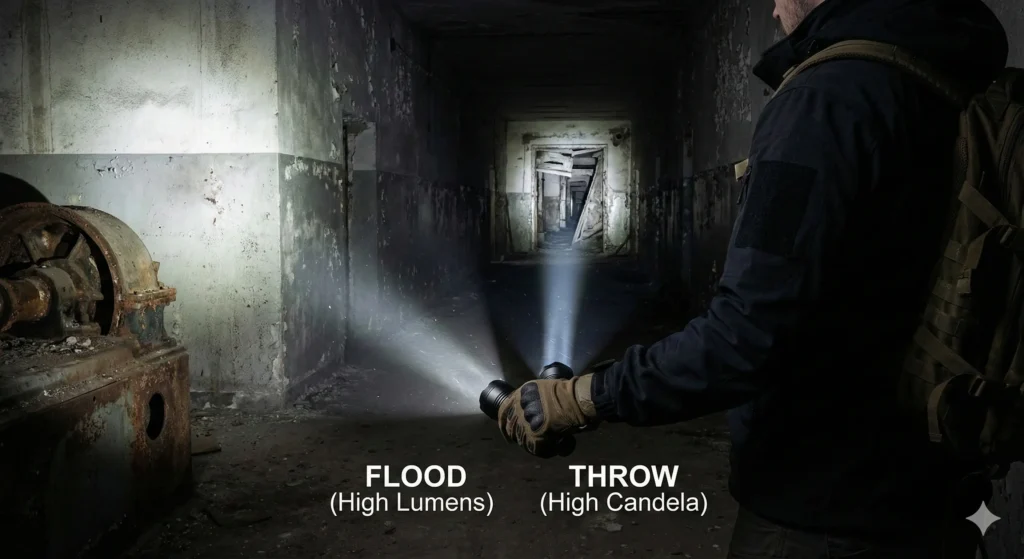
Lumens: The “Total Volume” of Light
Think of Lumens as the total amount of water coming out of a hose. It measures the total quantity of light emitted in all directions.
- High Lumens are great for “flooding” a small room with light.
- If you are a photographer trying to light up a whole classroom for a wide-angle shot, you want high Lumens.
Candela: The “Pressure” of the Beam
If Lumens are the water, Candela is the pressure. It measures the intensity of the light in a single direction—often called “Throw.”
- High Candela means the light is focused into a tight, powerful beam that can cut through a long, dark tunnel or reach the top of a collapsed elevator shaft.
- High Candela is what lets you “see into the distance.”
Which One Should You Prioritize?
For the modern urban investigator, you actually need a balance of both, or even two separate lights.
- The “Flooder” (High Lumens): This is your primary walking light. It provides a wide beam so you can see your immediate surroundings and avoid tripping. Look for something in the 1,000 to 2,000 Lumen range.
- The “Thrower” (High Candela): This is your scouting light. You use this to peer down long corridors or check the ceiling height in a warehouse. You want something with at least 30,000+ Candela.
Key Features to Look For
Beyond the brightness, there are three features that separate a professional flashlight from a household one:
- Color Temperature (CRI): For photographers, look for “High CRI” lights. These render colors accurately. “Cool White” lights can make everything look blue and sickly, while “Neutral White” makes the decay look more natural and textured.
- Battery Type: Avoid AAA batteries. Professional gear almost exclusively uses 18650 or 21700 rechargeable lithium-ion batteries. They last longer and provide the high voltage needed for those massive Lumen bursts.
- Waterproofing (IP Rating): Abandoned buildings are damp. You want a light rated at IPX7 or IPX8, meaning it can survive being dropped in a flooded basement or a rainstorm.
Pro-Tip: The “Low Mode” is Your Friend
Many beginners immediately turn their light to “Turbo” mode. Not only does this drain your battery in minutes, but it also ruins your “night vision” and makes it harder to see details in the shadows.
- Use the lowest setting possible to see where you are going.
- Save the Turbo for when you need to scan a large room or take a photo.
Conclusion
Your flashlight is your primary safety device. Investing in a high-quality light with a good balance of Lumens and Candela isn’t just about taking better photos—it’s about ensuring you always have a clear path back to the exit.