
Category: The Lab | Reading Time: 8 Minutes
When you step inside an abandoned asylum or a shuttered textile mill, your senses are immediately overwhelmed. You see the light filtering through the dust motes, you hear the wind whistling through broken glass, and you smell the unmistakable scent of damp concrete and ancient rot. It feels atmospheric even beautiful. But that atmosphere is hiding microscopic threats that your body is not equipped to handle.
In the urban exploration (Urbex) community, we often talk about the visible dangers: the weak floors, the rusty nails, and the security guards. However, the most long-lasting damage often comes from what you cannot see. Every breath you take in a decaying building could be introducing toxic fibers and spores into your respiratory system.
If you want to be exploring for decades to come, you need to understand why a simple cloth mask or a basic surgical mask is dangerously insufficient. You need a respirator. Here is everything you need to know about protecting your lungs in the field.
1. The Enemy: What Are You Actually Breathing?
To understand why you need a respirator, you first need to understand the three primary airborne threats found in almost every abandoned location built before 1980.
A. Asbestos (The Hooked Fiber) Asbestos was the “miracle material” of the 20th century. It was used in pipe insulation (often looking like white corrugated paper), floor tiles, ceiling “popcorn” textures, and fireproofing. When these materials age and crumble—a process called becoming “friable”—they release microscopic, needle-like fibers. When you inhale asbestos, those needles hook into the lining of your lungs. Your body cannot break them down or cough them out. Over 20 to 40 years, these fibers cause inflammation that can lead to Mesothelioma, a fatal and aggressive form of lung cancer.
B. Black Mold and Spores Abandoned buildings are damp, dark, and poorly ventilated—the perfect laboratory for Stachybotrys chartarum, or Black Mold. When you walk through a room, your footsteps disturb the carpet or the wallpaper, sending millions of spores into the air. Inhaling these can cause immediate allergic reactions, “Urbex flu,” and in severe cases, fungal infections in the lung tissue that require months of medical treatment.
C. Lead Dust Old buildings are covered in lead-based paint. As the building settles and the walls peel, that paint turns into a fine, heavy dust that settles on every surface. If you crawl through a crawlspace or even just walk briskly through a hallway, you kick that lead dust up. Lead poisoning is cumulative; it builds up in your system over time, affecting your nervous system and brain function.
2. Why Surgical Masks and Gaiters Fail
Many beginners wear a simple blue surgical mask or a “cool-looking” tactical neck gaiter. From a safety perspective, these are almost useless against the hazards listed above.
- The Seal Problem: Surgical masks are designed to catch large droplets coming out of your mouth; they are not designed to filter fine dust coming in. Because they don’t form a tight seal against your cheeks and nose, the “contaminated” air simply flows around the edges of the mask every time you inhale.
- The Micron Problem: Asbestos fibers and mold spores are measured in microns (tiny fractions of a millimeter). Cloth masks and standard gaiters have “holes” in the fabric that are massive compared to an asbestos fiber. It’s like trying to stop sand with a chain-link fence.
3. Choosing the Right Gear: P100 vs. N95
When shopping for protection, you will see various ratings. For urban exploration, there are two you should care about: N95 and P100.
- N95 (The Minimum): These filter 95% of airborne particles. They are decent for general dust but struggle with the finest asbestos fibers. If you use an N95, it must be a “cup style” mask with a metal nose clip to ensure a seal.
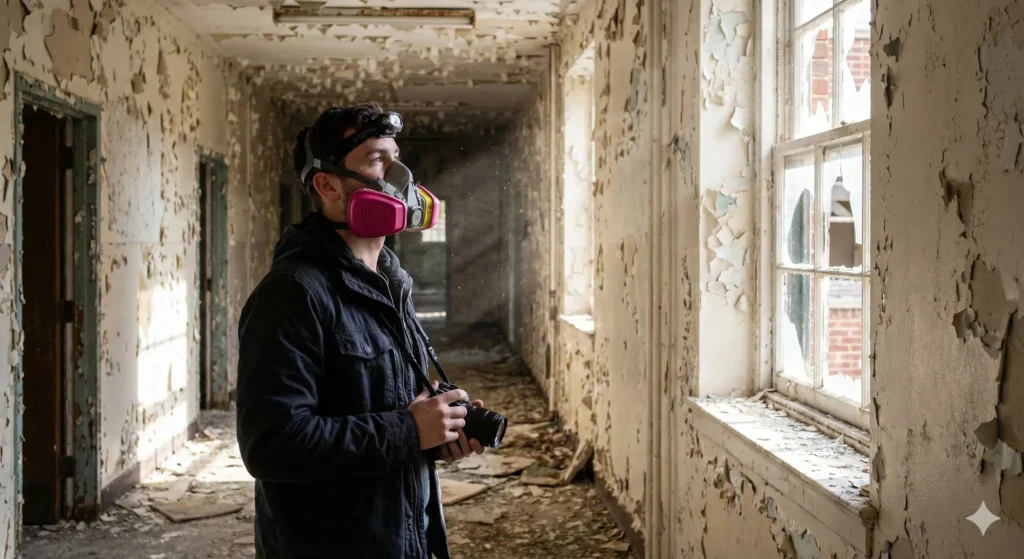
- P100 (The Gold Standard): P100 filters (often pink in color) filter 99.97% of all particles. Crucially, the “P” stands for “Oil Proof,” meaning they won’t degrade if they come into contact with industrial oils or mists. For asylums and industrial sites, P100 is the only rating you should trust.
4. Half-Face vs. Full-Face Respirators
If you are serious about the hobby, you should invest in a reusable silicone respirator body (like those made by 3M or Honeywell).
- Half-Face Respirators: These cover your nose and mouth. They are lightweight, relatively comfortable, and easy to fit in a backpack. They are the standard choice for 90% of explorers.
- Full-Face Respirators: These include a clear polycarbonate shield that covers your eyes. These are used in high-risk environments where the dust might be an eye irritant or where you want maximum protection. They also look very “tactical” for photography, but they are bulky and can fog up if not maintained.
5. Maintenance and The “Fit Test”
A $100 respirator is useless if it doesn’t fit your face properly. Here is how to ensure you are protected:
- The Negative Pressure Test: Put the mask on and tighten the straps. Cover the intake filters with your palms and breathe in. The mask should collapse slightly against your face and no air should leak in. If you feel a breeze on your eyes or chin, the fit is wrong.
- The Facial Hair Factor: This is an inconvenient truth: Respirators do not seal over beards. If you have a thick beard, the mask sits on the hair, creating thousands of tiny gaps for dust to enter. Professional explorers often stay clean-shaven or keep a very short stubble to ensure the silicone to skin seal is airtight.
- Filter Care: Filters don’t last forever. If you start to find it harder to breathe, or if you can smell “earthy” scents while wearing the mask, your filters are clogged or spent. Replace them immediately. Always store your respirator in a sealed Ziploc bag when not in use so the filters don’t “work” by filtering the air in your house.
Conclusion
We often spend thousands of dollars on cameras and lenses to document the “beauty of decay,” but we hesitate to spend $40 on a quality respirator. Don’t make that mistake. The buildings we love are beautiful, but they are also toxic.
Wearing a respirator doesn’t make you look “paranoid” it makes you a professional. Protect your lungs today so you can keep exploring tomorrow.