
Category: Historical Documentation | Reading Time: 10 Minutes
There is no location in the world of urban exploration more coveted or more misunderstood than the abandoned asylum.
When we see these massive, castle like structures rotting in the woods, it is easy to imagine them as places of pure darkness. Pop culture, horror movies, and ghost hunting shows have painted them as torture chambers designed by cruel doctors. But the reality is far more complex and, in many ways, more tragic.
These buildings were not built to be prisons. They were built to be palaces of healing. They represent one of the most ambitious social experiments in American history, an experiment that started with hope and ended in disaster.
To understand why we explore these places, we must understand the Kirkbride Plan and the rise and fall of the state hospital system.
1. The Era of Moral Treatment (1850 to 1900)
Before the mid 19th century, people with mental illnesses were often kept in local jails, almshouses, or hidden in basements by their families. They were treated as criminals or incurables.
Dr. Thomas Story Kirkbride, a Quaker physician, changed everything. He believed in Moral Treatment. He argued that environment played a crucial role in mental health. If you took a patient out of a dark, dirty city and placed them in a beautiful, sunlit building surrounded by nature, their mind could heal.
This philosophy birthed the State Lunatic Asylum. These were not just hospitals; they were self sufficient cities. They had their own farms, power plants, bakeries, and theaters. The state poured massive amounts of money into their construction, hiring the best architects of the Victorian era to build structures that commanded respect.
2. The Architecture of Light: The Bat Wing Design
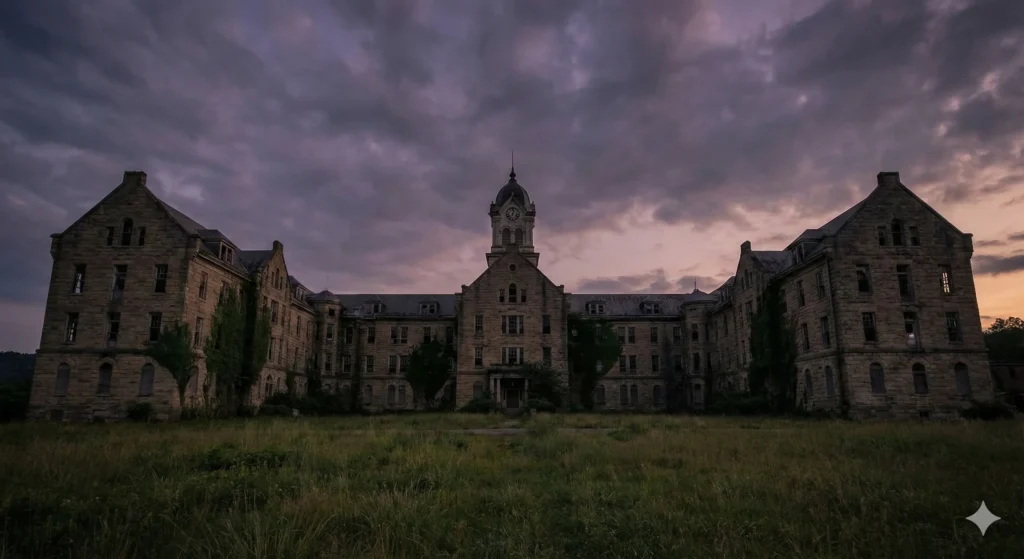
If you look at an aerial view of a classic asylum (like the Trans Allegheny Lunatic Asylum or the Danvers State Hospital), you will notice a very specific shape. They look like a bird or a bat with its wings spread.
This is the Kirkbride Plan.
Dr. Kirkbride dictated that:
- The Center Building (Administration): This was the head of the bat. It housed the doctors offices and lived in quarters for the superintendent. It was often incredibly ornate to impress visitors.
- The Wings (Wards): Stretching out to the left and right were long, staggered wings. Each wing was set back further than the previous one.
- Why staggered? This design ensured that every single window received fresh air and sunlight. No room was blocked by another.
- Ventilation: High ceilings and large windows were designed to circulate breeze, which was believed to flush out stagnant air and disease.
When you explore a Kirkbride building today, you are walking through a masterpiece of environmental psychology. The long hallways were meant to encourage walking; the large dayrooms were meant for socialization.
3. The Tipping Point: Overcrowding (1900 to 1950)
The plan worked too well. Families began sending their relatives to these hospitals in droves. Soon, the definition of mental illness expanded to include everything from senile dementia (Alzheimer’s) to alcoholism, menopause, or simply being a troublesome child.
The buildings were designed for 250 to 500 patients. By the 1930s, many held over 2,000.
The Collapse of Care:
- Beds in Hallways: The beautiful, sunlit corridors were lined with cots.
- Understaffing: With thousands of patients and only a handful of doctors, Moral Treatment became impossible. The goal shifted from curing patients to warehousing them.
- Neglect: With funding cut during the Great Depression and World War II, the buildings began to rot while people were still living in them. It was during this era that the horror stories, lobotomies, shock therapy without anesthesia, and patient abuse, became commonplace. The Palace of Healing had become a warehouse for the unwanted.
4. The Magic Pill: Thorazine and Deinstitutionalization
So, why are they all empty now? It was not because of a scandal. It was because of a molecule.
In 1954, the FDA approved Thorazine (chlorpromazine). It was the first antipsychotic drug. Suddenly, patients who had been violent or uncontrollable could be stabilized with a pill. They did not need 24 hour supervision in a massive stone castle anymore; they could be treated at outpatient clinics.
This triggered Deinstitutionalization.
Starting in the 1960s and accelerating in the 1970s (driven by budget cuts and civil rights lawsuits), the state governments began emptying the hospitals.
- The Exodus: Hundreds of thousands of patients were released. While the intent was good (community based care), the funding never followed. Many former patients ended up homeless or in prisons, swapping one institution for another.
5. The Remains: What We Find Today
By the 1990s, most of these massive complexes were fully closed. They were too expensive to heat, too full of asbestos to renovate, and too large to guard effectively.
For the explorer, a Kirkbride building is the Holy Grail.
- The Artifacts: Because they closed in waves, you often find layers of history. A 1950s X ray machine might sit next to a 1980s computer terminal.
- The Decay: The paint in these buildings often peels in massive, hanging sheets due to lead content and humidity. The institutional green color of the walls is iconic in urbex photography.
- The Hazards: These are dangerous places. The floors, often made of wood and damp for decades, are prone to collapse. The tunnels connecting the buildings (used to transport bodies and food) are often flooded and filled with black mold.
Conclusion
When we photograph an abandoned asylum, we must do so with a heavy dose of respect. We are not ghost hunting. We are walking through the bedrooms of people who were cast aside by society.
The peeling paint and the rusted bars are beautiful to the lens, but they are also a monument to a failed system. We document them to remember that good architecture and good intentions are not enough and that we must do better for the vulnerable than just hiding them away in a castle on a hill.
Over to you: Have you ever explored a Kirkbride building or a similar historical site? What was the atmosphere like? Share your experiences in the comments below.