
Category: Field Files | Reading Time: 8 Minutes
There is a unique sense of lost grandeur when you walk into abandoned train stations. These massive transit hubs were once the bustling gateways to American cities. Today, many of them sit completely empty, their grand waiting rooms echoing with silence instead of the whistle of departing locomotives.
This field file explores the rise and fall of these incredible architectural marvels. We will dive into the history of passenger rail, the economic shifts that led to their closure, and the stunning details that urban explorers still find hidden inside.
1. The Golden Age of Passenger Rail
During the late nineteenth and early twentieth centuries, railroads were the undisputed kings of transportation. Cities competed to build the most magnificent terminals possible. They hired world renowned architects to design soaring structures that looked more like Roman temples than transit stops.
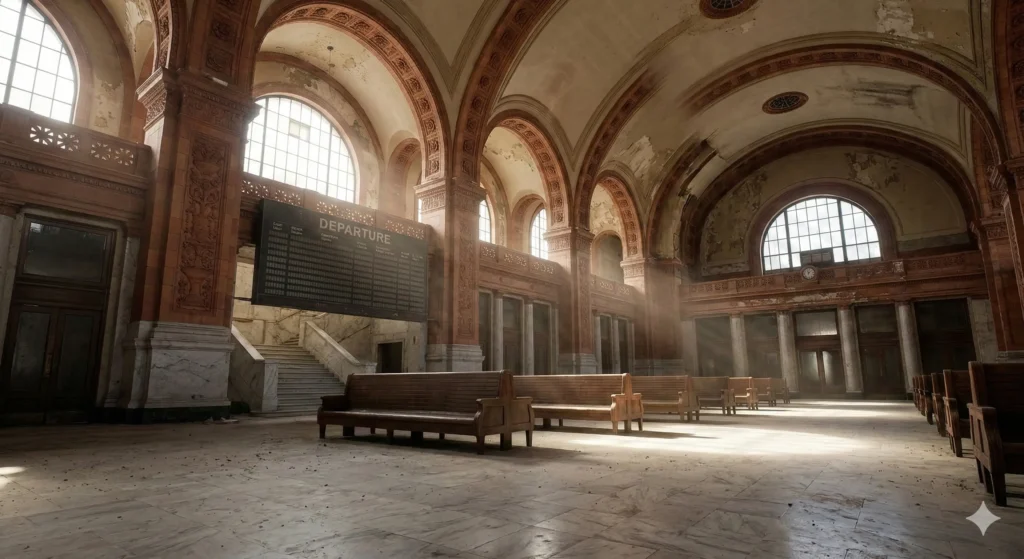
These buildings featured massive vaulted ceilings, intricate terracotta details, and sweeping marble staircases. The terminal was designed to impress travelers the moment they stepped off the platform. It was an era when travel was considered a luxury event, and the architecture reflected that immense pride and wealth.
2. The Rise of the Automobile and the Interstate
The decline of passenger rail began shortly after World War II. As cars became more affordable, the American public fell in love with the freedom of the open road. The federal government heavily subsidized this shift by building the massive interstate highway system.
Instead of buying a train ticket, families could simply pack up their car and drive wherever they wanted, whenever they wanted. At the same time, commercial air travel became accessible to the middle class. Trains simply could not compete with the speed of airplanes or the personal convenience of the automobile. As ticket sales plummeted, the massive upkeep costs of these giant terminals became an impossible financial burden.
3. The Freight Shift and Consolidation
As passenger numbers dropped, railroad companies shifted their focus almost entirely to moving freight. Transporting coal, grain, and manufactured goods was far more profitable than moving people. Many famous rail companies merged or went bankrupt during the mid twentieth century.
When the government stepped in to save passenger rail by creating Amtrak, they consolidated the routes. Hundreds of smaller cities and towns lost their passenger service entirely. The grand stations in these towns were abruptly boarded up and left to decay, while even massive hubs in major cities were demolished or downsized.
4. What Explorers Find Inside
For the architectural photographer, documenting abandoned train stations is an incredible experience. The scale of these buildings is difficult to comprehend until you are standing alone in the center of the main concourse.
Explorers often find rows of empty wooden benches, decaying ticket booths with the glass still intact, and massive departure boards frozen in time. The light filtering through the giant arched windows creates a cathedral like atmosphere. In the baggage handling areas below, you can often find rusted carts and forgotten maintenance equipment. It is a hauntingly beautiful environment that perfectly captures the feeling of a bygone era.
5. The Fight for Preservation
While many of these beautiful structures have been lost to the wrecking ball, there is a growing movement to save them. Historic preservation societies fight tirelessly to protect these buildings from demolition. Some have been successfully transformed into hotels, museums, or vibrant public markets through adaptive reuse projects.
However, for every station that gets saved, dozens more continue to rot. The sheer size of these buildings makes restoration incredibly expensive. Until funding is secured, these empty terminals will remain as silent monuments to the golden age of American transit.
Conclusion
Abandoned train stations represent a pivotal shift in how we connect with one another. They remind us of a time when the journey was just as important as the destination. While the tracks may be rusted and the waiting rooms empty, the history built into those stone walls remains undeniably powerful.
Over to you: Have you ever visited a beautifully restored train terminal or seen an abandoned one during your travels? Share your stories with us in the comments below!