
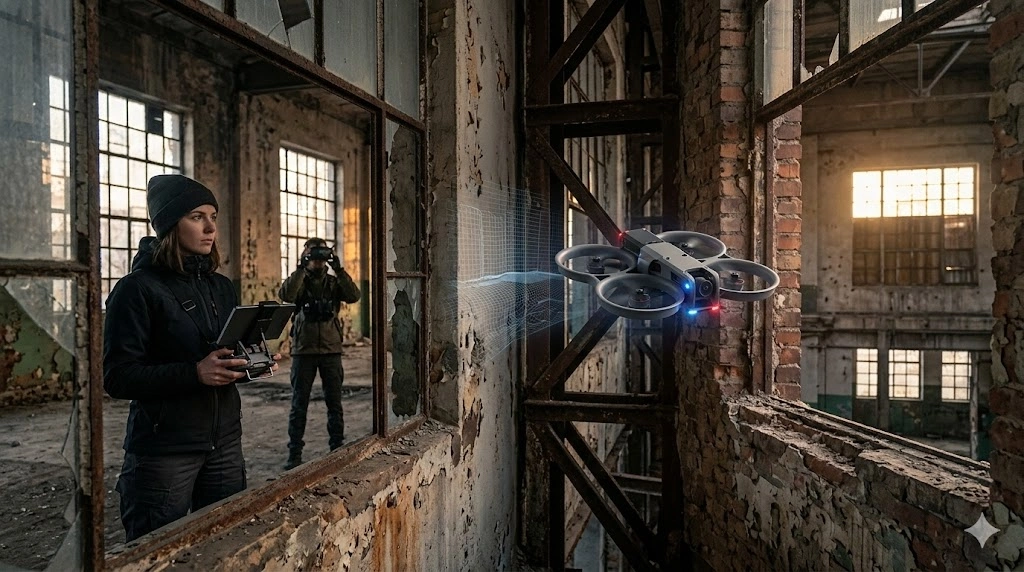
Using an indoor drone urban exploration strategy has completely revolutionized how we document abandoned spaces in 2026. Only a few years ago, flying a drone inside a crumbling factory or a tight hospital corridor was a high risk activity that usually ended in a catastrophic crash.
However, recent leaps in propulsion technology and autonomous sensing have turned these flying cameras into essential tools for the modern explorer. This technical analysis explores the current state of indoor flight hardware, the specific software settings required for signal heavy environments, and the critical legal landscape surrounding drone use in abandoned architecture.
1. The Rise of the 2026 Cinewhoop
The most significant hardware advancement for indoor drone urban exploration is the refinement of the Cinewhoop platform. Unlike traditional photography drones with exposed spinning blades, a Cinewhoop features integrated ducting or propeller guards. These guards allow the drone to literally bounce off a concrete pillar or a wooden door frame and keep flying without losing stability.
In 2026, models like the DJI Avata 2 and the newer DJI Neo 2 have set the standard for this category. These drones are incredibly small and lightweight, often weighing less than 400 grams. Their compact frames allow them to navigate through shattered windows or narrow ventilation shafts that would be impossible for a human to enter. For the explorer, this means being able to safely scout the upper floors of a building where the staircases have long since rotted away.
2. LiDAR and Night Vision Obstacle Avoidance
Flying indoors presents a massive problem for standard GPS based flight systems. Thick brick walls and reinforced concrete ceilings completely block satellite signals. In the past, this caused drones to drift uncontrollably.
Modern 2026 drones solve this issue using advanced LiDAR and downward facing optical flow sensors. LiDAR uses pulsing laser light to measure distances to walls and ceilings in real time, creating a three dimensional map of the surroundings. This allows the drone to hover with perfect precision even when no GPS signal is available. High end models now feature improved low light obstacle avoidance, which uses infrared sensors to detect jagged metal or hanging wires in pitch black basements. This technology acts as a digital safety net, preventing the pilot from making a fatal error in a dark environment.
3. Critical Indoor Flight Settings
To succeed at indoor drone urban exploration, you must manually override several default safety settings that are designed for outdoor use. The most important change involves your signal loss protocol. By default, most drones are set to Return to Home if the controller disconnects. Indoors, this is a recipe for disaster because the drone will immediately fly upward into the ceiling or a heavy light fixture.
You must change the signal loss setting to hover. If the connection drops, the drone will simply stay in place until you can move closer to regain control. Additionally, you should turn off smart return to home features that trigger when the battery is low. Managing your own battery levels manually ensures the drone does not perform an automated landing on a pile of debris or inside a flooded elevator shaft. Finally, many professionals disable standard obstacle avoidance in very tight spaces because the sensors may prevent the drone from moving through a narrow doorway. In these cases, you must rely entirely on your manual piloting skills.
4. Image Quality vs Portability
There is a constant technical struggle between camera sensor size and drone weight. Larger sensors like the one inch chips found in the DJI Air 3S or the DJI Mini 5 Pro provide incredible dynamic range and low light performance. However, these drones are larger and do not always have full 360 degree propeller protection.
For most indoor missions, a slightly smaller sensor is a fair trade for increased maneuverability. The 2026 generation of sub 250 gram drones has closed the gap significantly. These tiny machines can now record 4K video at high bitrates with impressive color depth. When paired with modern digital stabilization software, the footage looks as smooth as if the camera were on a professional gimbal. This allows you to capture cinematic fly through shots of decaying ballrooms that look like they were produced by a big budget film crew.
5. Legal Compliance and Remote ID in 2026
The legal landscape for drones has tightened significantly as of January 2026. In many regions, including the United Kingdom and the United States, new Remote ID requirements are now strictly enforced for any drone weighing more than a very small threshold.
Even though you are flying inside a private structure, you must still comply with national aviation regulations if the drone is capable of outdoor flight. Most 2026 drones automatically broadcast their identification and location data. It is your responsibility as an ethical explorer to ensure your gear is registered and that you are not violating any specific no fly zones or restricted airspace that might extend over the property. Always check local drone maps before you even unpack your controller to avoid heavy fines or equipment seizure.
Conclusion
Indoor drone urban exploration is no longer a niche hobby for elite pilots. The combination of LiDAR stability, duct protected propellers, and high resolution compact sensors has made it accessible to anyone willing to learn the technical requirements. These devices allow us to see parts of history that have been hidden for decades, providing a unique perspective on architectural decay while keeping the explorer safely on the ground.
Over to you: Do you prefer the cinematic look of a slow photography drone or the high speed thrill of an FPV Cinewhoop for your indoor shots? Let us know your favorite flight style in the comments section below!
Category: Tech Analysis | Reading Time: 10 Minutes
Using an indoor drone urban exploration strategy has completely revolutionized how we document abandoned spaces in 2026. Only a few years ago, flying a drone inside a crumbling factory or a tight hospital corridor was a high risk activity that usually ended in a catastrophic crash.
However, recent leaps in propulsion technology and autonomous sensing have turned these flying cameras into essential tools for the modern explorer. This technical analysis explores the current state of indoor flight hardware, the specific software settings required for signal heavy environments, and the critical legal landscape surrounding drone use in abandoned architecture.
1. The Rise of the 2026 Cinewhoop
The most significant hardware advancement for indoor drone urban exploration is the refinement of the Cinewhoop platform. Unlike traditional photography drones with exposed spinning blades, a Cinewhoop features integrated ducting or propeller guards. These guards allow the drone to literally bounce off a concrete pillar or a wooden door frame and keep flying without losing stability.
In 2026, models like the DJI Avata 2 and the newer DJI Neo 2 have set the standard for this category. These drones are incredibly small and lightweight, often weighing less than 400 grams. Their compact frames allow them to navigate through shattered windows or narrow ventilation shafts that would be impossible for a human to enter. For the explorer, this means being able to safely scout the upper floors of a building where the staircases have long since rotted away.
2. LiDAR and Night Vision Obstacle Avoidance
Flying indoors presents a massive problem for standard GPS based flight systems. Thick brick walls and reinforced concrete ceilings completely block satellite signals. In the past, this caused drones to drift uncontrollably.
Modern 2026 drones solve this issue using advanced LiDAR and downward facing optical flow sensors. LiDAR uses pulsing laser light to measure distances to walls and ceilings in real time, creating a three dimensional map of the surroundings. This allows the drone to hover with perfect precision even when no GPS signal is available. High end models now feature improved low light obstacle avoidance, which uses infrared sensors to detect jagged metal or hanging wires in pitch black basements. This technology acts as a digital safety net, preventing the pilot from making a fatal error in a dark environment.
3. Critical Indoor Flight Settings
To succeed at indoor drone urban exploration, you must manually override several default safety settings that are designed for outdoor use. The most important change involves your signal loss protocol. By default, most drones are set to Return to Home if the controller disconnects. Indoors, this is a recipe for disaster because the drone will immediately fly upward into the ceiling or a heavy light fixture.
You must change the signal loss setting to hover. If the connection drops, the drone will simply stay in place until you can move closer to regain control. Additionally, you should turn off smart return to home features that trigger when the battery is low. Managing your own battery levels manually ensures the drone does not perform an automated landing on a pile of debris or inside a flooded elevator shaft. Finally, many professionals disable standard obstacle avoidance in very tight spaces because the sensors may prevent the drone from moving through a narrow doorway. In these cases, you must rely entirely on your manual piloting skills.
4. Image Quality vs Portability
There is a constant technical struggle between camera sensor size and drone weight. Larger sensors like the one inch chips found in the DJI Air 3S or the DJI Mini 5 Pro provide incredible dynamic range and low light performance. However, these drones are larger and do not always have full 360 degree propeller protection.
For most indoor missions, a slightly smaller sensor is a fair trade for increased maneuverability. The 2026 generation of sub 250 gram drones has closed the gap significantly. These tiny machines can now record 4K video at high bitrates with impressive color depth. When paired with modern digital stabilization software, the footage looks as smooth as if the camera were on a professional gimbal. This allows you to capture cinematic fly through shots of decaying ballrooms that look like they were produced by a big budget film crew.
5. Legal Compliance and Remote ID in 2026
The legal landscape for drones has tightened significantly as of January 2026. In many regions, including the United Kingdom and the United States, new Remote ID requirements are now strictly enforced for any drone weighing more than a very small threshold.
Even though you are flying inside a private structure, you must still comply with national aviation regulations if the drone is capable of outdoor flight. Most 2026 drones automatically broadcast their identification and location data. It is your responsibility as an ethical explorer to ensure your gear is registered and that you are not violating any specific no fly zones or restricted airspace that might extend over the property. Always check local drone maps before you even unpack your controller to avoid heavy fines or equipment seizure.
Conclusion
Indoor drone urban exploration is no longer a niche hobby for elite pilots. The combination of LiDAR stability, duct protected propellers, and high resolution compact sensors has made it accessible to anyone willing to learn the technical requirements. These devices allow us to see parts of history that have been hidden for decades, providing a unique perspective on architectural decay while keeping the explorer safely on the ground.
Over to you: Do you prefer the cinematic look of a slow photography drone or the high speed thrill of an FPV Cinewhoop for your indoor shots? Let us know your favorite flight style in the comments section below!