
Category: Historical Documentation | Reading Time: 9 Minutes
There is a specific type of melancholy found only in an abandoned mansion.
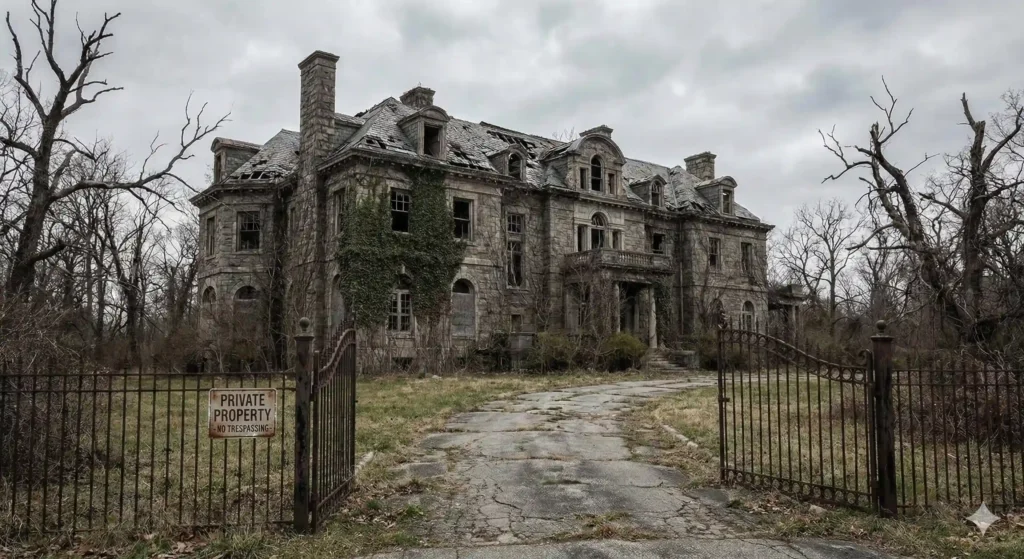
When you explore a factory, you see the ghosts of labor, grease stains, time clocks, and heavy machinery. When you explore an asylum, you feel the weight of suffering. But when you step into the rotting foyer of a 50 room estate built in 1910, you are confronting the spectacular failure of the American Dream.
You see grand staircases that once hosted socialites now covered in pigeon droppings. You see imported Italian marble fireplaces choked with ivy. You see ballrooms where orchestras once played, now silent except for the dripping of water through a collapsed roof.
These houses were built to last for centuries, yet many did not even last fifty years. This is the story of the Gilded Age, a period of unimaginable wealth, architectural arrogance, and the economic crash that left these American palaces to decay.
1. The Era of the Robber Baron (1870s to 1900s)
To understand these houses, you must understand the money that built them.
Before the Civil War, there were few millionaires in America. By 1890, there were over 4,000. The Industrial Revolution created opportunities for ruthless businessmen to monopolize entire industries, steel (Carnegie), oil (Rockefeller), railroads (Vanderbilt), and finance (Morgan).
Mark Twain famously coined this era The Gilded Age. It was glittering on the surface, but corrupt and rotting underneath. There was no income tax. There were few labor laws. The wealth gap was astronomical.
These Titans of Industry (or Robber Barons, depending on who you asked) suddenly had more money than European royalty. And they needed a way to show it.
2. Architecture as a Weapon
They did not just build homes; they built monuments to themselves. They hired architects trained in the Beaux Arts style of Paris to design Neoclassical palaces that rivaled anything in France or Italy.
- The Scale: These were not houses; they were compounds. They had 60 bedrooms, 30 bathrooms, indoor swimming pools, bowling alleys, and private theaters.
- The Materials: They did not use local wood. They imported marble from Carrara, limestone from Indiana, and mahogany from Honduras. They stripped European castles of their fireplaces and stained glass and had them shipped across the Atlantic to be reassembled in Ohio or New York.
- The Staff: A house like The Breakers in Newport, Rhode Island, required a staff of 40 servants just to function on a daily basis. There were separate hierarchies for the front of house staff (butlers, maids) and the back of house staff (cooks, laundresses, boiler men).
These houses were designed for one purpose: to intimidate. If you were a rival businessman invited to dinner, the sheer scale of the dining room was meant to make you feel small.
3. The Crash and the Tax Man Cometh (1913 to 1929)
The party could not last forever. Two major events signaled the death knell for the grand estate.
- The 16th Amendment (1913): The federal government introduced the income tax. Suddenly, the endless flow of cash had a spigot put on it. Even more devastating was the introduction of the Estate Tax (inheritance tax). When a tycoon died, his children suddenly had to pay the government up to 70% of the estate’s value in cash. Many had to sell the mansion just to pay the tax bill.
- The Great Depression (1929): Fortunes that took decades to build evaporated overnight. Families who were hosting 200 person balls in 1928 were struggling to keep the lights on in 1930.
4. The White Elephant Problem
Even for families that survived the crash, these mansions became impossible burdens.
They were incredibly expensive to run. Heating a 50,000 square foot stone castle with 1920s technology required massive amounts of coal and a dedicated staff of boiler men. As labor laws improved and wages rose, few families could afford the army of staff needed to maintain the grounds and polish the silver.
After World War II, cultural tastes changed. The children of the Robber Barons did not want to live in drafty, echoing museums that reminded them of a bygone era. They wanted modern, manageable suburban homes.
These estates became White Elephants, too expensive to live in, too expensive to maintain, and often too expensive even to demolish because of their sheer size and solid construction.
5. What We Find Today: The Melancholy of Excess
When urban explorers enter these spaces today, they often find a strange mix of grandeur and garbage.
Because they were often abandoned slowly, the valuable items (paintings, furniture) were sold off decades ago. What remains are the things that were too heavy or too bothersome to move:
- Grand Pianos: Almost every abandoned mansion has at least one rotting Steinway grand piano. They are too heavy to steal and too sensitive to survive without climate control. The humidity warps the wood and snaps the strings, creating a haunting visual.
- The Library: Massive, built in mahogany bookshelves often remain, sometimes still filled with water damaged leather bound books that were considered worthless by the heirs.
- The Plasterwork: The most tragic loss is often the ornate plaster ceilings. Water from leaking roofs gets behind the lath and plaster, causing massive, intricate medallions and crown moldings to crash to the floor in thousands of pieces.
Conclusion
Abandoned mansions are the American equivalent of Roman ruins. They are the physical remnants of an empire that rose fast, spent lavishly, and collapsed under its own weight.
Walking through them is a powerful reminder that money is fleeting. The gold leaf peels, the marble cracks, and eventually, nature reclaims the palace just as easily as it reclaims the shack.