
Category: Field Files | Reading Time: 7 Minutes
There is a unique silence that surrounds the abandoned grain elevators of the American Midwest.
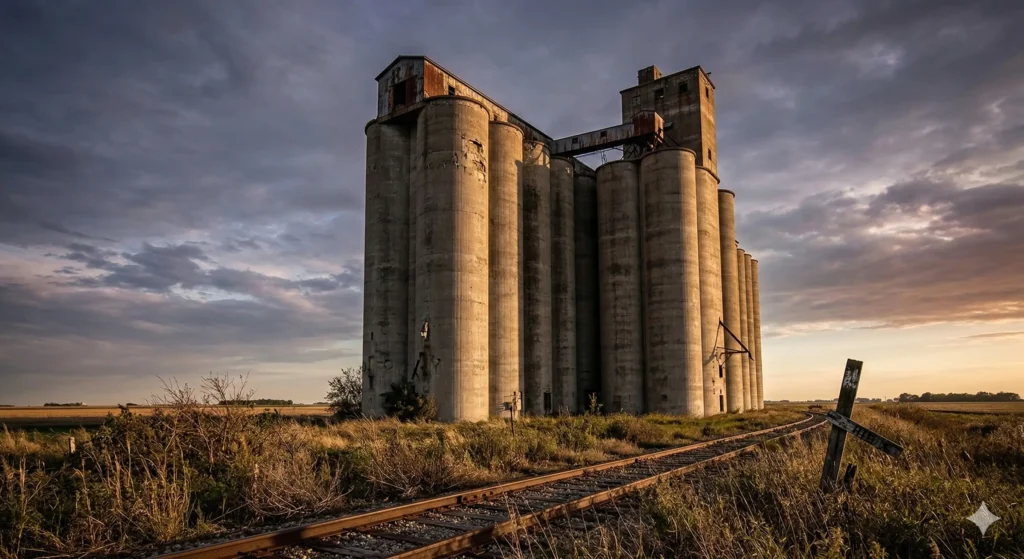
Rising like concrete monoliths from the flat prairie, these structures were once the beating heart of rural agriculture. Today, many stand empty, serving only as waypoints for urban explorers and architectural historians.
This field file examines the structural evolution and the inevitable decline of these agricultural titans, exploring why they were built to last forever and why they were ultimately left behind.
1. The Birth of the Prairie Skyscraper
Before the invention of the grain elevator, moving harvested crops was an incredibly labor intensive process. Farmers had to pack grain into individual sacks, load them onto wagons, and manually carry them onto trains or boats.
In 1842, a merchant named Joseph Dart changed everything. He invented a steam powered conveyor belt system equipped with scoops that could lift grain in bulk.
This innovation allowed for massive vertical storage. Entire towns sprang up around these new structures, which became the economic center of the agricultural world. If a town had a railroad stop and an elevator, it thrived. If it did not, it vanished.
2. Slip Form Concrete and Structural Evolution
The earliest elevators were built of wood, but they had a fatal flaw. Grain dust is highly combustible. After a series of devastating fires, engineers turned to a new, fireproof material, reinforced concrete.
To build these massive cylinders quickly, construction crews used a technique called slip forming. Concrete was poured continuously into a moving mold that slowly rose day and night until the silo was complete.
This created a seamless, incredibly strong structure designed to withstand immense outward pressure from thousands of tons of wheat. When you step inside an abandoned concrete elevator today, the sheer scale and the smooth, curved walls are a testament to this engineering marvel.
3. The Shift in the Agricultural Landscape
If these buildings were so vital, why are so many abandoned today? The answer lies in the evolution of the supply chain.
During the late 20th century, the railroad industry underwent massive consolidation. Small branch lines that served individual rural towns were abandoned.
Without trains to haul the grain away, the local elevators became useless. Agriculture shifted toward massive, centralized corporate facilities located on major highways or main rail arteries. The small town elevator simply could not compete with the speed and volume of these modern mega facilities.
4. Documenting the Monoliths
For the architectural photographer, these sites offer a study in pure geometry.
The intersecting cylinders create fascinating shadows as the sun moves across the sky. Inside, the basements often feature a maze of rusted conveyor mechanics, while the upper headhouses offer sweeping views of the surrounding flatlands.
However, they are also incredibly dangerous environments. The concrete can spall, the basements are frequently flooded, and the risk of poor air quality is high. Documenting these sites requires careful risk management and a deep respect for the agricultural history they represent.
Conclusion
These concrete giants are more than just empty silos. They are monuments to the farmers, the engineers, and the railroad workers who built the modern food supply chain.
As they slowly weather under the prairie sun, they stand as beautiful, stoic reminders of an era of American agriculture that has quietly passed by.
Over to you: Have you ever driven past one of these massive concrete structures on a road trip? Let us know what region you spotted them in down in the comments!