
Category: The Lab | Reading Time: 5 Minutes
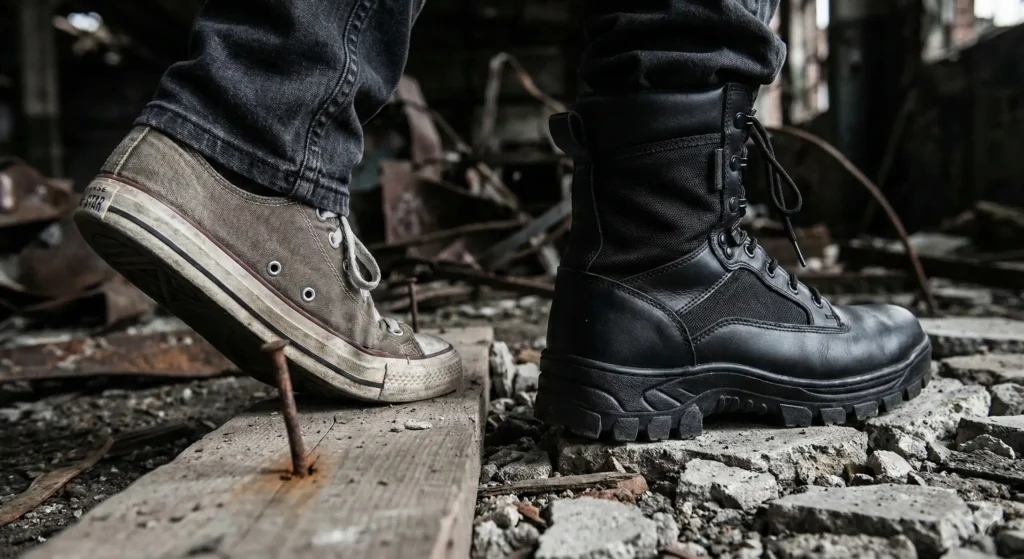
If you browse Instagram, you will see plenty of photos of people exploring abandoned buildings in Vans, Converse, or even sandals. These are photos of people who haven’t stepped on a rusty nail yet.
In the hierarchy of urban exploration gear, your flashlight lets you see the danger, but your boots protect you from it. An abandoned factory floor is a minefield of hazards that regular streetwear is not designed to handle.
If you are serious about this hobby, your first investment—before a new camera or a drone—should be a pair of dedicated, high-quality boots. Here is why sneakers are a liability in the field.
The “Puncture” Threat: Nails and Glass
This is the number one reason you need proper boots. The floors of abandoned buildings are often littered with debris.
- The Problem with Sneakers: A standard sneaker has a soft rubber sole. A rusty three-inch nail protruding from a piece of wood will go straight through that sole and into your foot with almost no resistance. This is not just painful; it introduces rust and bacteria deep into the wound, leading to severe infections like tetanus.
- The Solution: You need a boot with a thick, puncture-resistant sole. Many tactical and work boots feature a steel or composite plate built into the midsole specifically to stop sharp objects from penetrating through to your foot.
Ankle Support: Uneven Terrain
We walk on flat pavement every day, so our ankles aren’t used to uneven ground. Inside an abandoned location, “flat” doesn’t exist.
You will be climbing over piles of rubble, walking on warped floorboards, and navigating stairs with missing steps. If you are wearing low-top sneakers and your foot slips on a piece of wet concrete, there is nothing to stop your ankle from rolling. A severe sprain or break in a remote basement means you cannot walk out, turning a fun explore into a rescue mission.
A mid-height or high-top boot that laces up tightly provides the structural support your ankle needs to stay stable on unpredictable terrain.
Traction: Wet, Oily, and Slippery Surfaces
Abandoned buildings are damp. Roofs leak, pipes burst, and basements flood. This creates surfaces covered in slime, moss, and oil.
The tread on a casual shoe is designed for city sidewalks, not slick, industrial concrete. You need a boot with an aggressive, slip-resistant rubber outsole. Look for deep lugs that can grip into loose debris and a rubber compound that is rated for oily or wet surfaces.
Waterproofing: The inevitable Puddle
It is almost guaranteed that you will step in water. It might be a flooded basement, a puddle from a leaky roof, or a muddy path leading to the entrance.
Wet feet are miserable feet. But more importantly, in cold weather, wet feet can lead to hypothermia or frostbite much faster. A boot with a waterproof membrane (like Gore-Tex or similar) will keep your feet dry when you inevitably have to trudge through inches of standing water.
Conclusion
Don’t be the person whose trip ends early because a nail went through their shoe. Your feet are your mode of transport; protect them with the same seriousness you would protect your camera.
A good pair of tactical boots is not a fashion statement—it’s personal protective equipment (PPE).