
Category: Historical Documentation | Reading Time: 10 Minutes
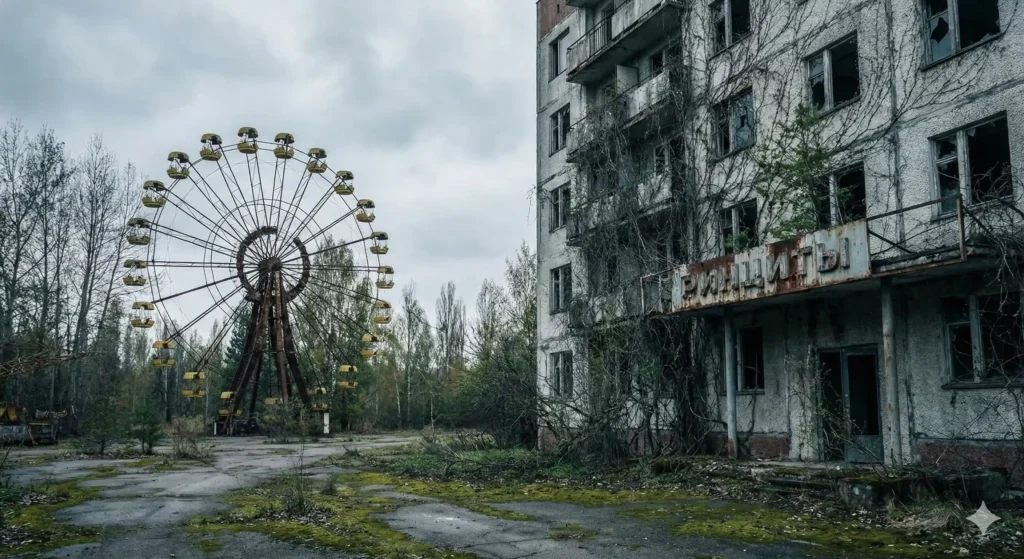
For the urban explorer, there is one location that stands above all others. It is the Mecca, the Holy Grail, the ultimate destination. It is the city of Pripyat, located in the Chernobyl Exclusion Zone.
While most abandoned places are the result of a slow, painful economic decline, a factory closing down, a family moving out, a hospital losing funding, Pripyat is different. It did not die of old age; it was murdered in a single night.
On April 26, 1986, the Number 4 reactor at the V.I. Lenin Nuclear Power Plant exploded. In the days that followed, an entire city of 50,000 people was evacuated. They were told to pack for three days. They never returned.
This created a unique phenomenon known as The Chernobyl Effect: a perfect preservation of a specific moment in history, frozen in time by invisible radiation. Here is why this site defines modern urban exploration.
1. The Atomic City and the Soviet Dream
To understand the tragedy, you have to understand what Pripyat was. Founded in 1970, it was a closed city, a prestigious model of Soviet efficiency designed specifically for the scientists and workers of the nuclear plant.
It was not a slum; it was a paradise. It had swimming pools, cultural palaces, amusement parks, and supermarkets stocked with goods that were unavailable in the rest of the USSR. The average age of the residents was just 26. It was a city of young families and bright futures.
When you walk through the ruins today, you are not just seeing concrete; you are seeing the shattered remains of the Soviet utopia. The propaganda posters still clinging to the walls promise a bright, atomic future that would literally blow up in their faces.
2. The 3 Day Lie: Why Everything Remains
The most haunting aspect of exploring Pripyat is the stuff. In a typical abandoned house in Detroit or Belgium, the owners have taken their valuables. Scrappers have stolen the pipes. Vandals have smashed the windows.
In Pripyat, the evacuation was ordered 36 hours after the explosion. To prevent panic, authorities told residents it was a temporary evacuation.
- The Artifacts: Because they expected to return, they left everything. Schoolbooks are still on desks. Toys are still on bedroom floors. Tables are set for meals that were never eaten.
- The Time Freeze: Walking into a Pripyat apartment is like walking into 1986. There are no artifacts from 1987. The calendars on the walls all stop in April. It is the purest time capsule on Earth.
3. The Liquidators and the Graveyard of Machines
The disaster did not end with the explosion. It required a massive cleanup effort involving over 600,000 men and women known as Liquidators. They were soldiers, miners, and firefighters sent into the most radioactive place on the planet to shovel graphite off the roof and build the Sarcophagus over the reactor.
This effort left behind its own ghostly monuments.
- The Vehicle Graveyards: For decades, fields in the Zone were filled with thousands of radioactive trucks, helicopters, and tanks used in the cleanup. They were too contaminated to leave. While many have been buried or scrapped recently, the sight of a rusted Mi 6 helicopter sitting in a field is a stark reminder of the battle fought here.
- The Gear: In the basements of the Pripyat hospital, you can still find the firefighter uniforms discarded by the first responders. They are incredibly radioactive to this day, a silent testament to the men who died to save Europe.
4. Radiation: The Invisible Hazard
Exploring the Zone requires a different kind of safety gear. You do not just need a flashlight; you need a Geiger counter (dosimeter).
- Hot Spots: The radiation in Pripyat is not uniform. You can stand in the middle of a street and be perfectly safe, but step onto a patch of moss or touch a metal drainpipe, and your dosimeter will scream.
- The Red Forest: The pine forest near the plant turned ginger red from the radiation and died. It remains one of the most contaminated places on Earth.
- The Danger of Dust: The biggest risk for modern explorers is not beams of radiation; it is ingesting radioactive dust. If you eat, smoke, or drink in the Zone, you risk swallowing particles of Cesium 137 or Strontium 90, which will irradiate you from the inside out.
5. Nature Reclaiming the Concrete
The most surprising discovery for visitors is that the Zone is not a dead wasteland. It is a lush, thriving nature reserve.
Without humans to hunt them or destroy their habitat, wildlife has returned. Wolves, bears, lynx, and Przewalski’s horses roam the empty streets. Trees are growing through the floors of gymnasiums and bursting through the roofs of apartment blocks.
It is a powerful lesson in resilience. Nature does not care about radiation; it cares about humans. Remove the humans, and life finds a way. The city is being consumed by the forest, slowly turning the concrete back into earth.
6. The Stalker Culture
Chernobyl has birthed its own subculture. Inspired by the Tarkovsky film Stalker and the video game series S.T.A.L.K.E.R., there is a community of illegal explorers who sneak into the Zone to camp in the radioactive apartments.
While legal tourism exists (and is safer), these Stalkers view the Zone as a spiritual place, a post apocalyptic frontier where the rules of society do not apply. They map the safe routes, hide water supplies, and document the decay before it disappears forever.
Conclusion
Chernobyl is the ultimate cautionary tale. It is a monument to human arrogance and the power of the atom. But for the urban explorer, it is also a place of profound beauty.
It forces us to confront our own impermanence. We build cities of steel and stone, thinking they will last forever. But Pripyat shows us that all it takes is one mistake, one button press, and nature will take it all back in the blink of an eye.
Over to you: If you had the chance to safely explore the Exclusion Zone, which specific building or landmark would be at the very top of your list? Let us know in the comments below!