
Category: The Unseen | Reading Time: 8 Minutes
Investigating forgotten ghost town folklore reveals a fascinating intersection between economic collapse and supernatural storytelling. Across the vast rural landscapes of America, there are hundreds of empty settlements where entire communities seemingly vanished without a trace. The local legends often blame these mass exoduses on terrible curses, demonic plagues, or vengeful spirits haunting the surrounding forests. However, when we step past the campfire stories and look closely at the decaying physical evidence, a much more grounded and tragic historical reality begins to emerge.
1. The Myth of the Sudden Disappearance
The most common trope in any story about an empty village is the idea that everyone left violently and at the exact same time. Rumors often describe half eaten meals left on rotting dining tables and schoolhouses where chalk still rests on the blackboards. This dramatic imagery makes for excellent regional mythology but rarely reflects the historical truth.
In reality, the death of a rural community is almost always a slow and agonizing process stretching across several decades. Families pack up their belongings and move away one by one as local opportunities dry up completely. The cinematic image of a town fleeing in terror from a supernatural threat is a complete fabrication designed to make the gradual decay of rural infrastructure seem more exciting to tourists and teenagers.
2. Economic Reality Versus Supernatural Fiction
When you research the actual municipal records of these legendary locations, the spooky curse is usually replaced by a harsh economic truth. Many of these mysterious settlements were built as temporary resource camps. They were corporate towns designed solely to support a nearby coal mine, a sprawling timber operation, or a lucrative gold vein.
Once the earth was stripped bare and the natural resources were entirely depleted, the massive industrial employers simply packed up their heavy machinery and left the region. Without a primary source of income, the local grocery stores and post offices quickly went bankrupt. The residents did not flee from ghosts or demons in the night. They fled from inescapable poverty and the threat of starvation.
3. Tracing the Forgotten Infrastructure
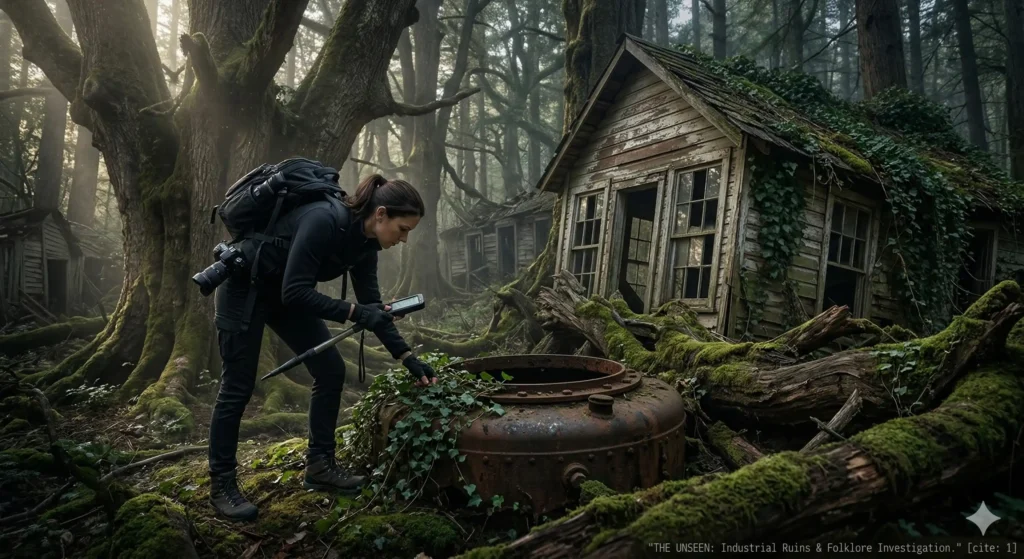
When you visit these undocumented locations today, your primary goal as a historical archivist should be identifying the remnants of this lost industrial machinery. Look beyond the collapsing wooden cabins and search the surrounding woods for the real story.
You might find rusted railway tracks buried under thick layers of pine needles or massive concrete foundations that once supported enormous lumber mills. Photographing these specific industrial artifacts provides vital context to the settlement. It visually proves that this was a highly functional working environment rather than a cursed patch of haunted land. By documenting the mechanical ruins, you honor the incredible physical labor of the people who actually lived and died there.
4. Oral History and Local Superstition
Even though the true cause of abandonment is usually economic, the local superstitions surrounding these places are still incredibly valuable to cultural anthropologists. Oral history provides a beautiful window into the anxieties of the people who lived in neighboring towns during the collapse.
When a neighboring village watches an entire community fail and turn into a rotting shell, it creates a deep sense of psychological unease. Inventing a scary story about a witch or a demonic creature is a psychological coping mechanism. It is much easier for people to blame a supernatural monster for the destruction of a town than to accept the terrifying reality that their own local economy could collapse just as easily tomorrow.
5. The Ethical Documentation of Lost Communities
Photographing a vanished settlement requires a deep level of emotional intelligence and ethical consideration. Even if the town has been completely empty for a hundred years, it is still a place where real families experienced profound loss and hardship. You are walking through the remains of their failed dreams and broken livelihoods.
You must never vandalize the remaining structures or steal old glass bottles from the debris piles. Your camera should capture the somber beauty of nature reclaiming the rotting wood and rusting steel. Treat the entire area as a solemn historical monument dedicated to the fragile nature of human civilization.
Conclusion
Separating historical fact from spooky fiction does not ruin the magic of exploring abandoned settlements. In fact, uncovering the true stories of economic struggle and industrial ambition makes these locations infinitely more compelling. By looking past the superficial myths, we can preserve the authentic memory of the hardworking pioneers who built these forgotten communities.
Over to you: Have you ever stumbled upon an undocumented historical ruin while hiking in the woods? How did it feel to stand in a place that the modern world completely forgot about? Share your exploration stories in the comments below!