
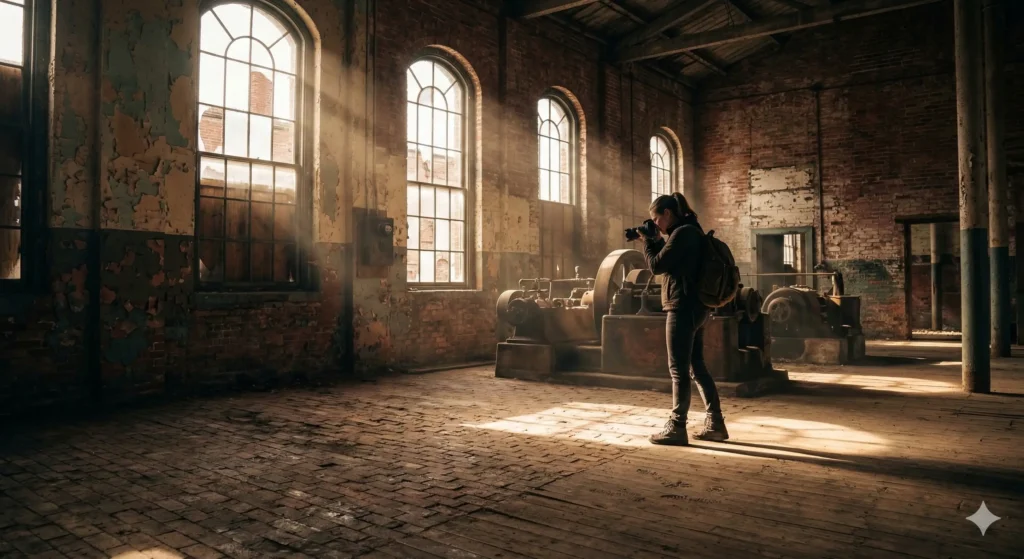
There is a specific kind of silence you only find inside an abandoned building. When the city noise fades away and you are standing in a decaying 19th-century factory or a forgotten hospital ward, it feels like you’ve stepped out of time.
That feeling is exactly why we explore. But as the urban exploration community grows, that silence is getting interrupted by broken glass, spray paint, and theft. If we want to keep documenting these incredible pieces of structural history, we need to talk about the Leave No Trace urbex rules. Following these guidelines isn’t just a suggestion; it’s the only way to ensure these sites survive.
What “Leave No Trace” Means for Us
You’ve probably heard the phrase used by hikers and campers. In the urbex world, the philosophy is simple: Take nothing but photographs, leave nothing but footprints, and break nothing but silence.
I learned this the hard way early on. I remember walking into [Insert a specific type of building, e.g., an old theater or mill] in [Insert a general region/state]. I was so excited to shoot the interior, but when I got inside, [Insert a short story about finding the place trashed, tagged, or stripped of its history]. It completely ruined the historical integrity of the site. It wasn’t a time capsule anymore; it was just a dumping ground.
From that day on, I made sure my exploration was strictly about documentation and preservation. Understanding the core Leave No Trace urbex rules is how you can do the same.
The 3 Core Rules of Ethical Exploration
If you are stepping into a forgotten place, you carry a responsibility to that location. Here is what ethical documentation actually looks like in the field:
1. We Never Force Entry
This is the big one. Ethical explorers do not bring crowbars. We don’t smash windows, cut padlocks, or kick hinges off doors. If a building is sealed tight, respect the seal.
Forcing entry turns you from a historical documentarian into a vandal. Not only is it a massive legal liability, but creating a new hole in a building allows the elements—and worse, scrappers and arsonists—to get inside and destroy the place. We look for open access points, and if there aren’t any, we walk away.
2. Don’t Touch the “Props”
The magic of an abandoned site is seeing how it was left on its final day of operation. Moving a rusty typewriter into a shaft of light might make for a cool Instagram photo, but it destroys the authenticity of the scene.
- Leave ledgers, tools, and personal artifacts exactly where they are.
- Don’t clear away debris just to get a cleaner shot.
- My personal rule in the field is… [Insert a quick, 1-2 sentence personal tip on how you handle cramped or messy rooms without disturbing the dust/items]
3. Why We Gatekeep Locations
People outside the community often get frustrated when we refuse to drop GPS coordinates or exact addresses in the comments section. But keeping locations undisclosed is one of the most vital Leave No Trace urbex rules.
The harsh reality is that the moment a pristine location goes viral, it gets destroyed. Foot traffic brings attention, attention brings vandals, and eventually, the property owners are forced to demolish the site. When I share my field files, my goal is to share the story of the region’s industrial or cultural past, not to hand out a tourist map.
Ethics Keep You Alive
Practicing Leave No Trace isn’t just about taking the moral high ground; it is actively tied to your physical safety.
When you refuse to force entry, you naturally avoid structurally compromised roofs and dangerous access points. When you move carefully to ensure you don’t disturb a scene, you are paying close attention to where you step—which is exactly what you need to do when navigating around black mold, asbestos, and rotting floorboards. [Optional: Add a one-sentence story about a time moving carefully saved you from a fall or hazard].
At the end of the day, our job as documentarians is to be ghosts. We observe, we record the history, and we fade out, leaving the site exactly as we found it for the next explorer.