
Category: The Lab (Gear) | Reading Time: 7 Minutes
An accurate urban exploration boots guide is essential because your feet are your primary mode of transportation and your first point of contact with a highly dangerous environment. When you step into a ruined factory, you are walking across a chaotic landscape of rusted nails, shattered safety glass, and slippery chemical spills. This equipment analysis breaks down exactly what features you must demand from your footwear to ensure you return home without a severe puncture wound.
1. The Importance of a Steel Toe
The absolute minimum requirement for any serious explorer is a hardened toe cap. While heavy leather offers some basic protection, it will not stop a falling brick or a collapsing steel pipe from crushing your foot.
Modern composite materials and traditional steel toe inserts provide a rigid shield against falling debris. This protection is completely nonnegotiable when you are navigating industrial locations where the structural integrity of the ceiling is highly questionable. You never know when shifting your weight might dislodge a piece of heavy masonry directly above you.
2. Puncture Resistant Soles
The most common injury in this field is stepping directly on a rusted nail protruding from a rotting wooden board. A standard running shoe sole offers absolutely zero resistance against a sharp metal spike under the full weight of your body.
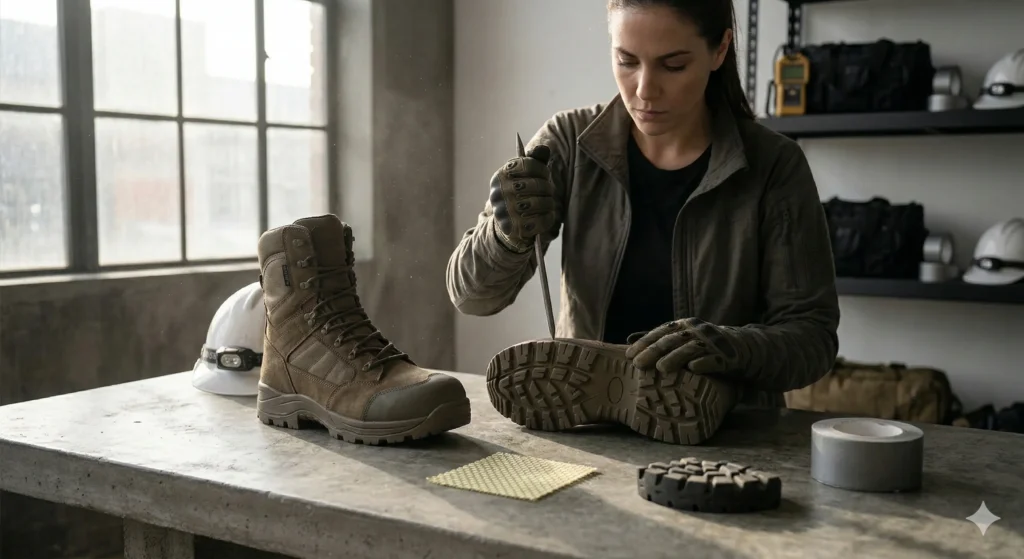
You must select boots that feature a specialized puncture resistant plate built directly into the midsole. These flexible steel or Kevlar inserts act as an impenetrable barrier, allowing you to walk confidently across construction debris without constantly staring at your feet. This invisible layer of armor is perhaps the most critical safety feature you can buy.
3. Ankle Support for Unstable Terrain
Abandoned buildings are rarely flat or predictable. You will spend hours balancing on narrow metal beams, climbing over massive piles of rubble, and descending steep staircases missing several steps. A low cut hiking shoe leaves your ankle completely exposed to severe twists and sprains.
A proper exploration boot must extend high above the ankle, providing rigid lateral support. Lacing your boots tightly around the upper ankle essentially locks the joint in place, preventing a simple slip from turning into a massive mobility emergency deep inside an undocumented location.
4. Slip Resistance and Tread Patterns
Water intrusion is a constant issue in decaying architecture. Basements frequently flood, and flat factory roofs leak massive amounts of rainwater onto smooth concrete floors. This creates incredibly slippery conditions, especially when the water mixes with old industrial oils and thick dust.
Your boots require a highly aggressive tread pattern made from specialized slip resistant rubber. The deep lugs channel water away from the contact patch, ensuring you maintain a solid grip even on wet algae covered tiles or slanted metal roofs.
5. Waterproofing Versus Breathability
Choosing between a completely waterproof boot and a highly breathable boot is a constant debate among professional documentarians. A fully waterproof membrane is fantastic for wading through shallow flooded tunnels, but it also traps your own sweat inside the boot during a long summer hike.
For most urban environments, a highly water resistant leather exterior treated with a heavy wax coating offers the best compromise. It will keep your feet completely dry if you accidentally step in a deep puddle, but it still allows enough airflow to prevent severe blisters from forming during a twelve hour expedition.
Conclusion
Investing in professional grade footwear is an absolute necessity for your physical safety. By prioritizing puncture resistance, ankle support, and heavy duty materials, you create a solid foundation for your entire loadout. A high quality pair of boots will comfortably carry you through the most hazardous environments, allowing you to focus entirely on capturing beautiful historical photographs.
Over to you: Do you prefer the heavy protection of a traditional leather work boot or the lightweight agility of a tactical military boot? Share your footwear preferences in the comments below!