
Category: The Lab (Gear) | Reading Time: 8 Minutes
Mastering your urban exploration lighting gear is the difference between capturing a beautiful architectural photograph and stumbling blindly into a dangerous hazard. When you enter a massive decaying factory or a subterranean hospital basement, you are completely at the mercy of the shadows. The power grid has been dead for decades. This equipment analysis explores the exact types of illumination devices you need to survive absolute darkness and safely document forgotten history.
1. The Primary Tactical Flashlight
Your primary handheld light is the most crucial piece of urban exploration lighting gear in your entire kit. You cannot rely on a cheap plastic flashlight from the local hardware store. You need a professional tactical light constructed from aerospace grade aluminum. This metallic body protects the delicate internal circuitry if you accidentally drop the device down a concrete stairwell.
Furthermore, you must look for a light with an incredibly high lumen output. A minimum of one thousand lumens is required to punch through the thick dust and illuminate the far end of a massive industrial warehouse. Always choose a model with multiple brightness levels so you can conserve battery power when you are simply walking down a narrow corridor.
2. The Necessity of a Headlamp
While a powerful handheld light is fantastic for scanning deep into the darkness, it occupies one of your hands. When you are climbing over a mountain of shattered brick or trying to balance on a rotting wooden floorboard, you absolutely need both hands completely free.
A dependable headlamp solves this problem perfectly. By mounting the light source directly to your forehead, the beam automatically follows your line of sight. This allows you to safely check your camera settings, read a physical map, or administer emergency first aid without ever plunging yourself into the dark. Look for a headlamp that features an adjustable tilt mechanism so you can angle the beam downward toward your feet while you carefully navigate the debris.
3. Redundancy and the Rule of Three
The golden rule of venturing into absolute darkness is that two equals one and one equals none. Electronic devices fail at the absolute worst possible moments. If you are three levels deep inside a windowless bunker and your only flashlight suddenly dies, you are in a life threatening situation.
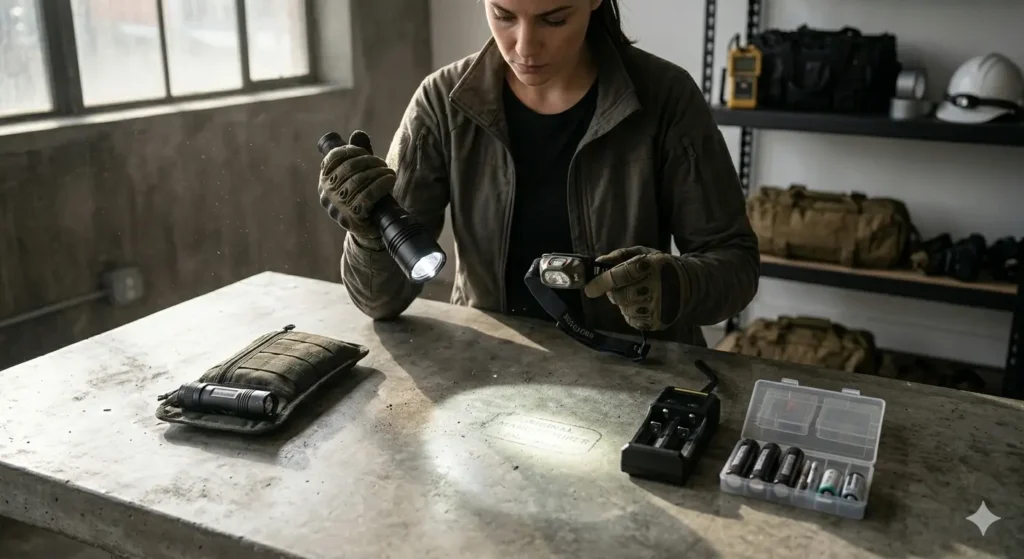
Every serious documentarian follows the rule of three for their urban exploration lighting gear. You must carry your primary tactical light, your wearable headlamp, and a third compact backup light sealed inside a waterproof pocket in your backpack. This strict redundancy ensures that you will always have a reliable way to find the exit door no matter what hardware failures occur.
4. Color Temperature and Photography
Your illumination tools are not just for basic navigation. They are frequently used to paint light into your photographs. Therefore, you must pay very close attention to the color temperature of the bulbs.
Cheap light emitting diodes often produce a harsh blue or green tint that makes architectural photography look completely unnatural. You should actively seek out flashlights that offer a neutral white or warm white color temperature. These warmer bulbs mimic natural daylight much more closely. When you use a warm light to illuminate a decaying brick wall or a rusted piece of machinery during a long exposure, the resulting photograph looks incredibly cinematic and professionally balanced.
5. Battery Chemistry and Management
The most powerful flashlight in the world is totally useless if the battery is dead. Modern urban exploration lighting gear relies heavily on rechargeable lithium ion batteries. These power cells offer an incredible capacity to weight ratio and perform exceptionally well in freezing temperatures.
However, you must manage your power consumption aggressively. Always start every single journey with fully charged batteries inside your devices. More importantly, you must carry at least two spare sets of fully charged batteries inside protective plastic cases. Never let loose lithium batteries rattle around in your bag because they can easily short circuit against your keys and start a severe fire inside your backpack.
Conclusion
Building a reliable illumination kit requires careful thought and a commitment to redundant safety systems. By investing in a high quality tactical flashlight, a comfortable headlamp, and proper lithium power management, you can confidently conquer the darkest environments. Proper equipment allows you to focus entirely on documenting the historical decay around you instead of worrying about what might be hiding in the shadows.
Over to you: What is your absolute favorite brand of tactical flashlight? Do you prefer a warm beam or a cool white beam for your night photography? Share your gear recommendations in the comments below!