
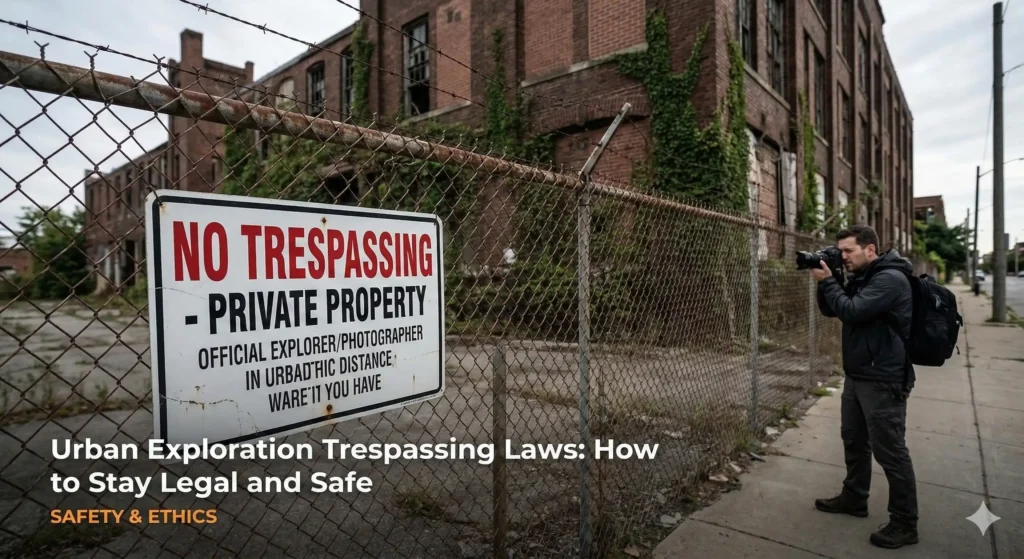
Category: Safety & Ethics | Reading Time: 8 Minutes
Disclaimer: This article is for educational purposes only. We strictly advocate for obtaining legal permission before entering any property. Entering private property without explicit consent is illegal and dangerous.
Urban exploration trespassing laws are the most critical subject any photographer or historian must understand before stepping foot onto an abandoned property. While the allure of decaying architecture is incredibly strong, ignoring the legal boundaries can result in severe fines, confiscated camera gear, and even permanent criminal records.
This guide breaks down the complex legal landscape of exploring forgotten places. We will discuss the reality of property ownership, the severe consequences of breaking the law, and the proper methods for securing permission so you can document history safely and legally.
1. The Myth of the Truly Abandoned Property
The biggest mistake new explorers make is assuming that an empty, rotting building belongs to no one. In the eyes of the law, there is no such thing as unowned property. Every single square inch of land in the country is owned by a private citizen, a holding corporation, a bank, or a local government entity.
Just because a factory has been empty for forty years does not give the public the right to enter it. The owner still pays taxes on that land and they still carry the legal liability if someone gets hurt inside. Therefore, crossing the property line without permission is legally defined as trespassing regardless of the condition of the building.
2. Understanding Civil versus Criminal Trespass
It is vital to understand the difference between civil and criminal offenses when discussing urban exploration trespassing laws.
Civil trespass generally occurs when you wander onto a property by accident without causing any damage. The property owner can ask you to leave, and if you comply immediately, the situation usually ends there.
Criminal trespass is a much more serious offense. This occurs when you knowingly and intentionally enter a property where you are not allowed. If you climb over a locked fence, walk past a clearly posted no trespassing sign, or ignore purple paint on trees which legally signifies no trespassing in many states, you are committing a criminal act. Law enforcement can arrest you on the spot for this offense.
3. The Dangerous Line of Breaking and Entering
There is a massive legal difference between walking through an open gate and forcing your way into a building. If you use any amount of physical force to gain entry, you elevate your crime from simple trespassing to breaking and entering.
This includes cutting a padlock with bolt cutters, prying open a boarded up window, or even turning the knob of a closed but unlocked door. Breaking and entering is a severe felony charge. AdSense policies and ethical exploration guidelines strictly prohibit promoting or engaging in these illegal activities. The golden rule is simple: if there is no wide open and completely unobstructed way inside, you must turn around and walk away.
4. The Consequences of Getting Caught
If law enforcement catches you inside an abandoned structure without permission, the penalties can be life altering.
First, you face immediate arrest and steep financial fines that can easily run into thousands of dollars. Second, police officers have the authority to confiscate all the equipment used during the commission of the crime. This means they can permanently seize your expensive cameras, lenses, tripods, and even your vehicle. Finally, having a criminal trespassing charge on your permanent record can severely damage your future employment opportunities and background checks.
5. How to Secure Explicit Legal Permission
The only way to completely bypass urban exploration trespassing laws is to do the hard work of securing explicit legal permission from the property owner.
You can use public county tax assessor websites to look up the exact address of the abandoned property and find the registered owners name and contact information. Send them a polite, professional letter or email explaining that you are a historical photographer wanting to document the architecture. Offer to sign a strict liability waiver that protects them from lawsuits if you get injured on their property. You will be surprised by how many owners will gladly unlock the gates for a respectful photographer who asks politely.
Conclusion
Documenting forgotten history is an incredibly rewarding passion, but it is never worth risking your freedom or your future. By understanding the legal boundaries and putting in the effort to seek proper permission, you elevate yourself from a simple trespasser to a legitimate historical archivist.
Over to you: Have you ever successfully tracked down a property owner to get permission for a photo shoot? What strategies worked best for you? Share your tips in the comments section below!