
Category: Historical Documentation | Reading Time: 9 Minutes
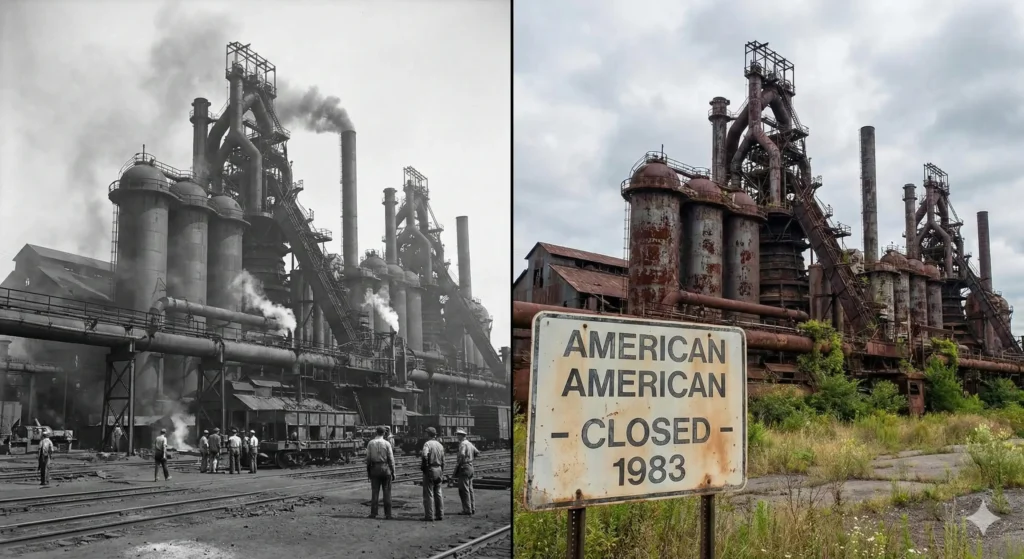
When you walk into an abandoned steel mill, like the massive complexes in Bethlehem, Pennsylvania, or the ghostly remains of Detroit’s Packard Plant, you are walking into a cathedral. The ceilings are soaring, the silence is heavy, and the machinery, even in its rusted state, feels powerful. These buildings were not just factories; they were the engines that built the modern world.
For the urban explorer, the “Rust Belt” is a playground of texture and light. But to understand what you are looking at, you need to understand the history behind the decay. You are not just photographing rust; you are documenting the physical remains of an economic empire that collapsed.
This is the story of how American Steel rose to dominate the globe, why it fell so spectacularly, and why these silent giants are now the most coveted locations in the urbex community.
1. The Titan Awakens: 1870 to 1945
The story begins with the Second Industrial Revolution. Before this era, iron was brittle and hard to mass produce. But with the invention of the Bessemer Process (and later the Open Hearth furnace), it became possible to turn molten iron into steel, a material that was lighter, stronger, and flexible.
Suddenly, skyscrapers became possible. Suspension bridges could span rivers. Railroads could cross continents.
By the early 20th century, companies like U.S. Steel (founded by J.P. Morgan and Andrew Carnegie) were the most powerful corporations on Earth. They did not just build factories; they built entire towns. Cities like Gary, Indiana, and Pittsburgh, Pennsylvania, existed solely to feed the blast furnaces.
The War Machine: World War II was the peak. American steel mills produced the tanks, ships, and planes that defeated the Axis powers. At its height, the U.S. was producing more than 50% of the entire world’s steel. The mills ran 24 hours a day, the sky over Pittsburgh was permanently black with soot, and the workers were the backbone of the American middle class.
2. The Golden Age and the Slow Rot: 1945 to 1970
After the war, America was the only major industrial power left standing. Europe and Japan had been bombed into rubble. For two decades, American steel had zero competition.
This monopoly led to complacency. The massive corporations stopped innovating. They kept using the older, slower Open Hearth furnaces because they were already built and paid for. Meanwhile, rebuilt factories in Germany and Japan were forced to start from scratch. They adopted the newer, more efficient Basic Oxygen Furnace (BOF) technology.
While American executives were comfortable, the rest of the world was catching up, and they were doing it faster, cheaper, and cleaner.
3. The Collapse: The Crisis of the 1970s and 80s
The bubble burst in the 1970s. A combination of factors created the perfect storm that would eventually turn these factories into the abandoned ruins we explore today.
- The Oil Crisis (1973): Energy costs skyrocketed. Steel production is incredibly energy intensive. The older American mills, which were inefficient fuel hogs, suddenly became too expensive to run.
- Foreign Competition: Japanese and European steel, produced in modern factories with lower labor costs, flooded the U.S. market. It was higher quality and cheaper.
- Labor Disputes: Strikes and high wage demands, while justifiable for the dangerous work, made American steel even less competitive globally.
“Black Monday” (September 19, 1977): In Youngstown, Ohio, huge portions of the Youngstown Sheet and Tube Company closed overnight, laying off 5,000 workers instantly. This triggered a domino effect across the region. Between 1970 and 1990, the steel industry lost over 300,000 jobs.
The blast furnaces went cold. The trains stopped running. The towns that relied on them began to crumble. The “Manufacturing Belt” became the “Rust Belt.”
4. The Anatomy of a Mill: What We Find Today
For the explorer, understanding the process helps you identify what you are seeing.
- The Blast Furnace: The towering, vertical structures where iron ore, coke (fuel), and limestone were melted down. These are often the most dramatic structures left standing, looking like rusty rockets.
- The Casting House: The massive, open floor spaces where the molten steel was poured into molds. This is where you often find the giant ladles and overhead cranes.
- The Rolling Mill: Long, linear buildings where red hot steel ingots were squished between rollers to make sheets, beams, or rails. These buildings can be half a mile long, creating incredible vanishing points for photography.
5. Why Preservation Through Photography Matters
Today, most of these sites are being demolished. The scrap metal in an abandoned steel mill is worth millions of dollars. Every year, another “Cathedral of Industry” is torn down to make way for an Amazon warehouse or a parking lot.
This is why we explore. When we photograph a control room covered in 1980s dust, or a locker room where a worker left their boots 40 years ago, we are preserving a moment in time. We are documenting the cost of progress.
These ruins are monuments to a different era, an era of American dominance, of hard labor, and of a way of life that has largely vanished.
Conclusion
The next time you squeeze through a fence to photograph a rusting beam, remember what it represents. You aren’t just looking at junk. You are looking at the skeleton of the 20th century.
The fires are out, but the history remains, as long as we are there to capture it.